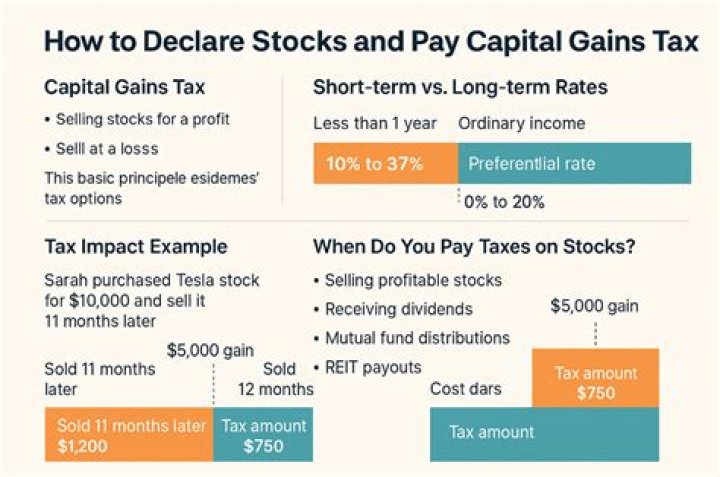
Learn about federal tax brackets.) Long-term capital gains tax is a tax on profits from the sale of an asset held for longer than a year. Long-term capital gains tax rates are 0%, 15% or 20% depending on your taxable income and filing status.
How much taxes do you pay on stock gains?
2020 capital gains tax rates
| Long-term capital gains tax rate | Your income |
|---|---|
| 0% | $0 to $53,600 |
| 15% | $53,601 to $469,050 |
| 20% | $469,051 or more |
| Short-term capital gains are taxed as ordinary income according to federal income tax brackets. |
How much tax is owed on a stock you sold?
You might be able to offset some of your stock sale capital gains with stock sale capital losses. Long-term gains from the sale of some types of stock, such as Section 1202 qualified small business stock, may be taxed at up to 28 percent.
How to calculate the sale price of a stock?
Sell price:Sell price:Share price when sold:Share price when sold: Share price when sold: Enter the price per share at the time the shares are sold. Or enter the price per share as of today to calculate a what-if scenario. Share price when sold No text Learn More Commission paid at sale:
How to calculate the yield on a stock?
Current yield: This is the current yield at the time of the sale. To arrive at the current yield, the stock calculator divides the annual dividend per share by the price per share at the time of the sale. Learn More Annual yld:Annualized yield:Annualized holding period yield:Annualized holding period yield: Annualized holding period yield:
How to calculate the annualized holding period yield?
Annualized holding period yield: This is the annualized holding period yield. To arrive at this figure, the stock calculator divides the total return on investment by the total original investment, and then multiplies that result by 1/N, where N is the number of years the investment is held.