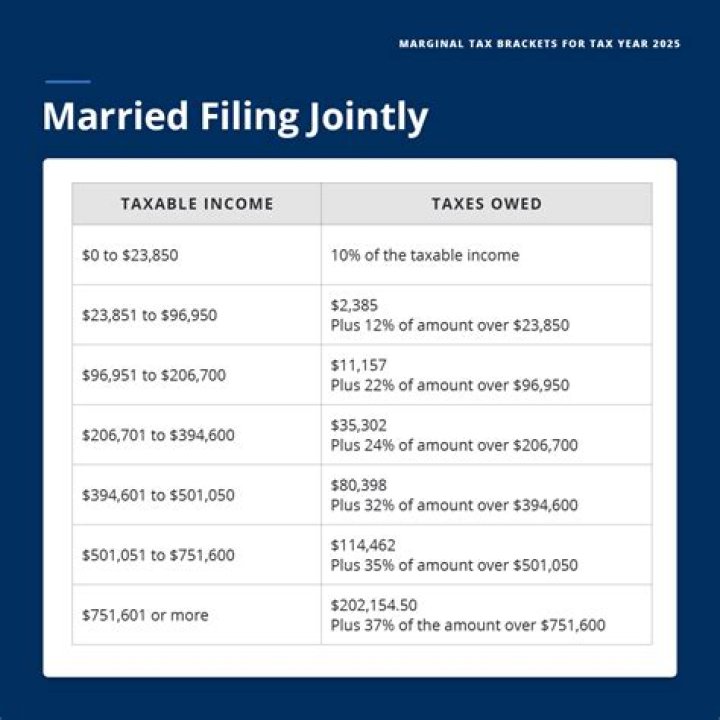
What is the Married Filing Jointly Income Tax Filing Type? Married Filing Jointly is the filing type used by taxpayers who are legally married (including common law marriage) and file a combined joint income tax return rather than two individual income tax returns.
What’s the top income tax rate for married couples?
The Tax Cuts and Jobs Act (TCJA) stipulated that the personal exemption has been removed. For married couples filing jointly, the top rate of tax has remained the same at 37%. To qualify for the top rate of tax, you must have earned more than $622,050.
Is it better for a married couple to file jointly or separately?
In the vast majority of cases, it’s best for married couples to file jointly, but there may be a few instances when it’s better to submit separate returns. Married couples have the option to file jointly or separately on their federal income tax returns.
Do you pay less tax if you file jointly?
This means that in most cases, you will pay less income tax overall by filing jointly. In many states, married couples who choose to file separately are subject to additional restrictions.
How is a tax bracket determined for a single person?
As mentioned above, determining your tax bracket hinges on two things: filing status and taxable income. Here are some useful details: Single Filing – Unmarried, legally separated and divorced individuals all qualify all single. Married Filing Jointly – A married couple agrees to combine income and deduct the allowable expenses.
What are the income tax brackets for 2019?
The top marginal income tax rate of 37 percent will hit taxpayers with taxable income of $510,300 and higher for single filers and $612,350 and higher for married couples filing jointly. Table 1. Tax Brackets and Rates, 2019
What are the federal tax brackets for 2021?
The standard deductions for each filing status for 2021 are: 1 Single: $12,550 2 Head of household: $18,800 3 Married filing separately: $12,550 4 Married filing jointly: $25,100 5 Qualifying widow (er): $25,100 More …
How does married filing jointly work in Canada?
The Canadian counterpart is known as Canada Revenue Agency (CRA). Married filing jointly allows two married individuals in the U.S. to combine their income tax return into one filing; however, both spouses are equally responsible for the tax return.
What happens when you file a joint income tax return?
You become jointly and severally liable for all taxes due when you file a joint return, even on income that your spouse personally earned. 2 This means that if you earned $20,000 and your spouse earned $80,000, the IRS can collect the taxes due on that $80,000 from you if she doesn’t pay them.
How to find out if you should file jointly or separately?
The best way to find out if you should file jointly or separately with your spouse is to prepare the tax return both ways. Double check your calculations and then look at the net refund or balance due from each method. If you use TurboTax to prepare your return, we’ll do the calculation for you,…
What’s the maximum earned income credit for Married Filing Jointly?
As you can see, this is a relatively minor increase when compared to the previous year. The Earned Income Credit (EIC) has been increased for married couples filing jointly to $6,660 for 2020. This represents a minor increase from the maximum in 2019. The maximum amount can be claimed if you have three or more qualifying children.
What’s the maximum tax deduction for a married couple?
Tax Credit and Deduction Changes. The Earned Income Credit (EIC) has been increased for married couples filing jointly to $6,660 for 2020. This represents a minor increase from the maximum in 2019. The maximum amount can be claimed if you have three or more qualifying children.
What happens if only one spouse has income?
This means that if only one spouse has income, you are effectively doubling the standard deduction amount by filing jointly, since there’s no advantage to the no-income spouse taking the $12,000 deduction for filing separately on $0 income. Personal exemptions no longer exist in tax year 2018.